VOLUME 26, ISSUE 26 | JULY 3, 2026 |
WHAT COPYCATTING SAYS
By copycatting, I'm talking about you copying someone's style, plagiarizing their description, stealing a story concept, or using AI. The creative world is anti-AI, in case you hadn't noticed, and regardless of what those using it are saying, readers do want to know if a human or
machine wrote it. Readers are not ignorant creatures who only want a good story regardless where it comes from. To think so is being insulting and naive. What copying says about the writer -you do not respect the reader
-you do not respect yourself
-you feel you don't have enough talent
-you are not beyond cheating to make a buck The second that many readers hear that you used AI is when you lose face. Readers assume you don't have the skills to do it from scratch. Readers see you as a thief and a con and lacking talent. You can argue that you learn from what AI does for you. No, you don't, because you didn't use that part of your brain to learn it. You let something else find an answer and you just copied it. You didn't
learn it. We can only pray that one day originality will be compensated and respected as more valuable than bot-think. |
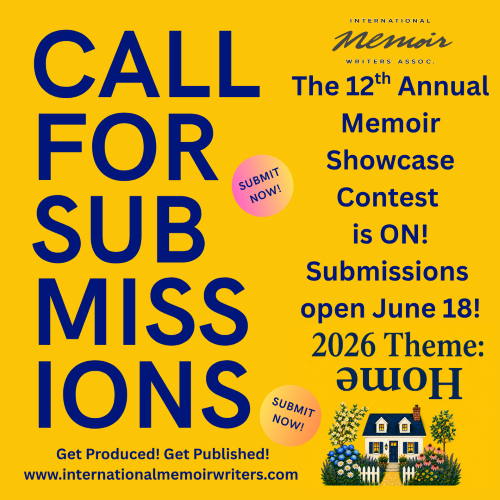
Memoir Showcase Season Has Officially Begun! The Memoir Showcase is our annual contest for five-page true stories, and it’s special because there are two ways to get published: - The 12th Annual Theatrical Memoir Showcase. Nine winning stories are
professionally edited and brought to life on stage by professional actors and directors at our live performance at 7 p.m. on Friday, November 20, 2026, in The Garfield Theater in La Jolla, California. Your words. Their voices. A room full of readers, writers, and memoir lovers watching your story come alive on stage.
- Volume 10, Shaking the Tree: brazen. short. memoir. An additional twenty stories are selected for editing and
publication in the milestone tenth edition of our acclaimed anthology series, due out in early 2029.
One submission. Two opportunities for publication. (And if you’re selected for this year’s Memoir Showcase, your piece will also appear in Shaking the Tree, Volume 10.) Open to new and experienced writers. This could be your year! This year’s theme: Home. Submissions Close: August 1 CON VERSUS CON
I recently was contacted via Messenger by someone wanting to promote me via their offerings at LuminLeaf. She wanted to send me information, call me, talk about a promotional package. However,
when questioned, she couldn't give testimonials, couldn't give her own experience or qualifications, couldn't tell me the humans behind the company, much less the country they hailed from. Gmail email. There are no websites or social media for the authors who have supposedly paid for all this promo. Some of the books are on Amazon, with single digit numbers in reviews. The company's Facebook page has followers that scream fake. The
hilarious part is that on their Facebook page (with minimal followers, BTW), another predatory promoter tried to pitch the author of a book the first predatory promoter was supposedly promoting. Then another. They were feeding off each other! LOL "Hello Author, I came across your post and it caught my attention.
We’re here to feature your book and boost its visibility through our reader community.
You can reply
here or email us at [email protected]." Then someone else stepped up. "This story already carries such a strong emotional presence. The chemistry, mood, and intensity come through so naturally that it feels like the Kind of book readers would instantly picture in their minds while reading. A cinematic teaser could bring that feeling to life visually and help people connect
with the story's atmosphere within seconds of seeing it online. I create cinematic book trailers that help romance authors present their stories in A more immersive, visually compelling, and memorable way across social media. If you'd like, I can share a few samples." I laughed out loud at how they were preying on each other. Con versus con. These cons have gravitated
from emails to social media. They ask you to follow their page and they follow you. Quite predatory. Regardless what they promise you, don't fall for it. If it sounds too good. . . you know the drill. But most of all, if they cannot show you their resume, their experience, their big successes at what they profess to do, then just shut down communication with them. Don't be that desperate author who hopes that this is the real deal and fall for it anyway. There are no shortcuts in this business.
Just enjoy the hilarity of the attempted con and move on. -July 25, 2026 - Smoking
Guns Sisters in Crime Zoom meeting - Noon - Zoom -August 17, 2026 - Saluda County Library, Saluda, SC - 5:30-7 PM -August 29, 2026 - Saturday Writers Group - noon Eastern - Zoom -September 9, 2026 - Lexington Book Club - 220 W. Main St, Lexington, SC - 10:30 AM -October 27-28, 2026 -
SC Library Conference, Columbia Convention Ctr - lunch speaker -November 15-21, 2026 - Edisto Beach, signings TBD
Email: [email protected] to schedule events, online or otherwise. “We are responsible to ourselves for our own existence; consequently we want to be the true helmsman of this existence and refuse to allow our existence to resemble a mindless act of chance.” — Friedrich Nietzsche (1844–1900)
Fact-Checked Mistakes That Can Cost You Clients, Credibility, and Income
By Millicent Mwololo Lagat I'd always worked directly with my editor. We'd go back and forth, smooth out phrases,
maybe tweak a section or two, and then the piece would move forward to the publication phase. But one day, she said she wanted to pass the copy to a fact-checker first. Admittedly, in the era of AI, everything needs an extra human eye. However, the process wasn't what I expected. It completely slowed down my piece. What I thought was a clean draft suddenly came back with lots
of questions; small details that didn't quite line up, a date that needed confirming, a quote that couldn't be verified the way I'd presented it and a request for contact information for the expert sources listed in the article. This was enough to stop the piece in its tracks. It was the first time I realized that what I submitted was being read and tested before it was published, and I wasn't really prepared. What should have been a straightforward edit turned into two weeks of back-and-forth. I had to retrace sources, confirm details, and rework sections that would have been fine if I'd caught the issues earlier. None of that time was billable. Both the publication and payment dates shifted. That's the part no one talks about: fact-checking mistakes don't just affect accuracy, they affect cash flow.
There's no longer room for error. When a Fact Checker Steps in, the Standard Changes More publications are working with fact-checkers now, either in-house or freelance. Their job isn't to "improve" your piece, it's to verify it line by line. They're checking names, titles, dates, timelines, quotes, and statistics, in my experience, often down to the smallest
comma. If something doesn't match, it doesn't just get quietly corrected. It comes back to you, and sometimes, it escalates quickly. Not every consequence is obvious. You might still get paid for the piece even if you cannot prove your sources, but behind the scenes, things shift. Your work may get routed through stricter checks, editors may build in extra time for your pieces, and you may stop being the "easy yes" when assignments
come up. Editors don't usually announce that they've lost confidence, they adjust quietly. And in freelance writing, being easy to work with is part of what keeps our income steady. What I Changed Immediately After that experience, I stopped treating fact-checking as something I do at the end and
built it into how I write. I verify details as I go. If I include a date, statistic, or claim, I confirm it right then instead of assuming I'll catch it later. Whenever I reach out to experts for a quote, I cc my editor in those conversations so she can be more confident in my process. Every key detail in my draft has something I can point back to quickly, no guessing, or digging after submission. I double-check even the details that seem too small to matter. Names, job titles, locations are the first things a fact-checker will flag. And before I submit, I step away, even briefly. Coming back with fresh eyes catches more than a rushed final read ever will. None of this is complicated. But it's the difference between a clean submission and a time-consuming fix. Fixing mistakes after
submission is unpaid work, and I've found that "mostly accurate" isn't accurate enough. Small errors create bigger doubts than you expect. Unfortunately, editors notice patterns, even if they don't say anything. Now I see fact checking as part of getting paid consistently. Because the writers who submit clean, reliable work get rehired and are trustworthy. And that consistency matters more than any single paycheck. It translates to protecting your time, reputation, and income, before anyone else has to question it.
BIO - Millicent Mwololo Lagat is a writer who focuses on stories that matter. She enjoys the ins, outs and in-betweens of the writing world. https://muckrack.com/millicent-mwololo
ID 8298008 © Wd2007 | Dreamstime.com
GUTSY GREAT NOVELIST PAGE ONE PRIZE $20 ENTRY FEE. Deadline
Thursday, July 16, 2026. The 7th Annual Gutsy Great Novelist Page One Prize is awarded for an outstanding first page of an unpublished novel. First prize is $1,000; 2nd is $500; and 3rd is $250. The prize is open internationally to anyone over 18 writing a novel in English in any genre for adult or YA readers (fiction only). Winners will be announced Thursday, August 27, 2026. THE MORIARTY AWARD
https://www.bellcowproductions.com/award
$50 ENTRY FEE. Deadline April 30, 2027. An annual prize recognizing the literary villain or antagonist who slinks off the page and into our psyches, challenging our morals,
testing our loyalties and reminding us why tension—real, nail-biting tension—is the beating heart of storytelling. Presented annually (beginning in 2027) to the author who gives us a villain or antagonist so complex, so cunning, so unnervingly human, that readers will think about him/her/it long after the book is closed. Eligibility: fiction published in the 2026 calendar year. Cash prize: $500. Moriarty Award Medal. Guest appearances at the Minnesota Mystery Night, Masters of Mystery, and
Writers' Corner. FRACTURED LIT FICTION CONTEST
https://fracturedlit.submittable.com/submit
$20 ENTRY FEE. Deadline July 12, 2026. No themes. No prompts. Just your wildest imaginations and your best, most engaging flash and microfiction. The first-place winner will
receive $2,000 and publication, while the fifteen finalists will receive $100 and publication. All entries will be considered for general publication. Allows up to two stories of 1,000 words or fewer each per entry. DRIFTWOOD SHORT STORY CONTEST
https://www.driftwoodpress.com/adriftstorycontest
$30 ENTRY FEE. Deadline July 15, 2026. Fiction only. 1,000-6,000 word limit. The winner will receive $500 dollars and five copies of the anthology in which the story appears. The winner will also have the opportunity to be interviewed about their work; the interview will be published alongside the story. If a runner-up is chosen, their work will be offered publication, an accompanying interview, $200, and
five copies of the issue in which their work appears. GRATEFUL AMERICAN BOOK PRIZE
https://www.davidbrucesmith.com/2026-grateful-american-book-prize-call-for-submissions/
NO ENTRY FEE. Deadline July 31, 2026. Accepting
submissions for outstanding historical fiction, non-fiction, and biographies for readers, ages 11 to 15. Eligible books must be published between August 1, 2025, and July 31, 2026. The winner will receive a $13,000 award, a lifetime membership to The New York Historical, and a medallion designed by artist Clarice Smith. Two Honorable Mention recipients will receive $500, each, and the medallion. Self-published books do not qualify. THE
ADROIT JOURNAL EDITOR’S PRIZES IN POETRY & FICTION
https://theadroitjournal.org/editors-prizes-in-poetry-and-fiction
$15 ENTRY FEE. Deadline July 31, 2026. The recipient of the Editor’s Prize in Poetry and the recipient of the Editor’s Prize in Fiction will each receive $1,000 and publication in an
upcoming issue. Poetry: Submit 1–3 poems in a single document. Fiction: Submit 1 short story (max 6,000 words recommended). Writers may enter in both the Poetry and Fiction categories. Writers of all backgrounds, nationalities, ages, and stages are welcome to submit. We will only consider the first 300 submissions received in each genre. Once 300 submissions are received, the submission category will automatically close. GRANTS / FELLOWSHIP / CROWDFUNDING RLF GRANTS - UK
https://www.rlf.org.uk/apply-for-a-grant/
The three types of grants we offer are designed to support writers through difficult periods, whether that means helping with everyday essentials like rent, utilities and groceries, or
easing the additional costs that can come with long-term health conditions or unexpected financial strain. Back-to-Work Grants are usually offered as an outright award to cover up to six months of essential expenses. Stability & Recovery Grant offers flexible support to cover essential living expenses while you navigate a difficult period. Literary Contribution Grants provide long-term, sustained support for writers who have made a significant literary contribution and are unable to cover
the basic living costs through work, pensions or benefits. HUGO BURGE FOUNDATION
https://www.hugoburgefoundation.org/grants
Deadline July 31, 2026. The Creative Individuals Fund will have £50,000 available in 2026 and is open to individuals seeking support for the
development of artistic projects or practice. We welcome applications from practitioners in all creative disciplines and individuals across the UK are welcome to apply. The maximum award for individual artists is £5,000. ECONOMIC HARDSHIP REPORTING PROJECT
https://economichardship.org/pitch-portal/
https://economichardship.org/submission-guidelines/
The Economic Hardship Reporting Project is a nonpartisan, nonprofit organization that produces compelling journalism on economic inequality in America. We give grants to independent journalists reporting on issues related to
poverty, economic class, workers’ rights, and income disparity in the U.S., and co-publish their work in partnership with major media outlets. Many of our contributors are journalists struggling to financially sustain themselves in the increasingly low-paying media industry. THE GRAND PLAN
https://www.grandplanfund.co.uk/application-guidance
Grand Plan is for people of colour, aged over 18, living in the UK, looking to make a leap with their creative practice. In particular, we try to support projects and people that might not easily find funding elsewhere. Our grants can cover: the cost of equipment, courses, your time, materials, travel, or whatever you / your project needs.
MOTHERSHIP
https://www.mothership.blog/write-for-us/
Here at Mothership, we have a specific focus: the intersection of games and identity, specifically as it pertains to gender, sexuality, and the bodies we inhabit in reality and in games. By
“games,” we mean console games, video games, PC games, tabletop games, and mobile games. Email your idea to team(at)mothership.blog and keep it concise (under 300 words). Tell us your estimated word count; know that if you’re proposing to publish 2,000 words or more, we expect the topic to be utterly fascinating. Articles at Mothership start at a baseline rate of $250 per story. WINEMAKER
https://winemakermag.com/writers-guidelines
WineMaker is for anyone who is interested in making wine, from those starting out with kits to more advanced winemakers who use fresh fruit. We seek articles that are straightforward and factual, not full of esoteric theories or complex calculations. We count on our writers to provide illustrations with articles. Our pay scale ranges from $75 to $300
depending on the length and complexity of the article as well as the experience of the writer. We buy all rights, and payment is made upon publication of the article. LINUX MAGAZINE
https://www.linux-magazine.com/About-Us/Write-for-Us
Linux Magazine is looking for authors to
write articles on Linux and the tools of the Linux environment. We like articles on useful solutions that solve practical problems. Articles are usually about 800 words per page, although code listings and images will reduce this. RACONTEUR
https://www.raconteur.net/write-for-us
At Raconteur,
we’re interested in what connects business. From the rise of the four-day week to supply chain risk to the journey to net zero, we want to tell the stories impacting leaders and driving change in the business world. Pieces tend to be between 1,000 and 1,200 words, although they can go up to 2,000. ALSO...We are always in need of freelance writers to work on commercial content. If you’d like more information about this, please email [email protected] and pop ‘commercial content’ in the
subject line. SWITCHBOARD
https://www.switchboardmagazine.com/about
https://docs.google.com/document/d/1N3b9FSmNq-JKbgCthKqie-S3SR_OCQnUyPIuc_2Fk_4/edit?tab=t.0
Switchboard Magazine is a digital publication committed to reshaping the landscape of narrative storytelling. Once a month, we publish original nonfiction and fiction that celebrates diverse voices and viewpoints, sharing stories grounded in emotional truth. We prioritize quality writing, character-driven narratives, and rigorous craft. Accepted short stories receive a $500 payment
and will be actively positioned to film and television producers for potential adaptation opportunities. Any revenue generated from adaptations will be split 50/50 between the writer and Switchboard. Commissioned long form narrative authors receive a $2,000 payment, and the stories will then be actively positioned to film and television producers for potential adaptation opportunities. Any revenue generated from adaptations will be split 50/50 between the writer and Switchboard.
IMMEDIUM
https://www.immedium.com/contactus/submissions.html
Currently Immedium is focused on publishing in the following book categories:
Children's Picture Books: The general format is 32-pages with color illustrations for ages 4-8
or 6-10.
Asian-America: Contemporary viewpoints on our evolving national identity and changes that have universal resonance.
Arts and Culture: Cutting-edge commentary on the intersection of popular culture, social trends, and our modern lifestyle. WOODHALL PRESS
https://www.woodhallpress.com/submissions
Woodhall Press welcomes agented and un-agented manuscript submissions. We have published emerging writers, poet laureates, and New York Times best-selling authors. We are interested in works that surprise, delight, and shatter norms. Poetry, CREATURE
https://creaturehorror.com/submit
Creature accepts both agented and unsolicited submissions of feminist horror, dark speculative fiction, women-driven thrillers, spooky fantastical fiction, literary fiction, or genre-defying prose. We are looking for books that celebrate fluidity—the ability to cross boundaries and inhabit more than one category at once. FOX CHAPEL PUBLISHING
https://foxchapelpublishing.com/pages/author-inquiries
Publishes illustrated, nonfiction, instructional books for children and adults, as well as three quarterly magazines. No novels, short stories or poetry. Their book subjects have expanded to include quilting, sewing, coloring, activity books, children's books, home repair, cookbooks, gardening, homesteading, wood
working, scroll saw, pets, travel, journals, and more.
FUNDSFORWRITERS FINE PRINT Please forward the newsletter in its entirety. To reprint any editorials, contact [email protected] for permission. Do not assume that acknowledgements listed in your publication is considered a valid right to publish out of ours.
C. Hope Clark
E-mail: [email protected]
140-A Amicks Ferry Road #4
Chapin, SC 29036
http://www.fundsforwriters.com Copyright 2000-2025, C. Hope Clark
ISSN: 1533-1326 Our subscriber list is NOT made available to others. Use information listed at your own risk. FundsforWriters gives no warranty to completeness, accuracy, or fitness of the markets, contests, and grants although research is done to the best of our
ability. FundsforWriters finds open submission calls, contests, and markets from a wide variety of sources, including Erika Dreifus' Practicing Writer
newsletter, Erica Verrillo's blog, Authors Publish, Poets & Writers, Duotrope, Winning Writers, Write Jobs Plus, LinkedIn Jobs, Emily Stoddard, and other newsletters and online sites. Many announcements are submitted directly to FundsforWriters. All must be paying opportunities. Contests must pay a minimum of $200 first place. Submit potential listings to [email protected] **Note that FundsforWriters.com places paid advertising in this newsletter. ALL ads are related to writers and the business of writing, screened by FundsforWriters to make sure the information is suitable for writers and their endeavors to improve their careers. While the mailing list is
not sold to third parties, other parties do advertise in the newsletter, to include the occasional solo ad. You will not receive this newsletter without your permission. It's physically impossible since recipients must opt-in, giving us permission to send the newsletter. If at any time you no longer wish to receive the newsletter, click the UNSUBSCRIBE link at the bottom of each newsletter. We want you to enjoy this newsletter at your pleasure, not be forced to read anything you do not wish to
receive. Direct any complaints, suggestions, and accolades to Hope Clark at [email protected]. We are an anti-spam site. | |
|
|
|