VOLUME 26, ISSUE 22 | MAY 29, 2026 |
ANOTHER SUCCESS I think we are all tired of hearing bad news, disgruntling news, and news that makes us debate whether or not to keep writing. So I want to share some good news with you from one of you. Dear
Hope,
I look forward to receiving your newsletter every Friday. It has broadened my awareness of off-the-beaten-path publishing and writing opportunities. I read about West 44 Books in your newsletter and am thrilled to announce that my YA novel-in-verse, Songcoming, will be published by them this
summer! When Eve meets a merman in the creek, she must choose between a life under water where she can't breathe—and a life on land that will surely suffocate her. As a HI/LO (High-Interest, Low-Readability) book in verse and haiku, Songcoming is written to engage diverse reading levels. https://storytellinginnovation.com/songcoming/Thank you for supporting writers with your weekly resources!Best wishes,Torran AndersonDirector, Center for Storytelling Innovationstorytellinginnovation.com |
Creative Nonfiction 101: Using the Tools of Fiction to Tell True Stories
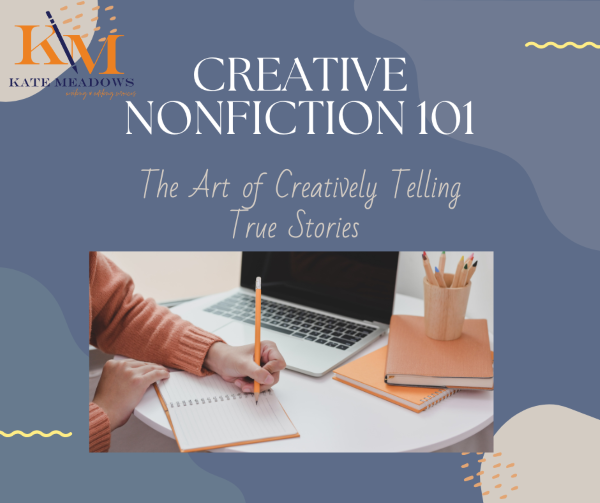
What if your real-life experiences could read like a page-turner? On Saturday, May 30, I'll lead a one-hour webinar called,
"Creative Nonfiction 101." We'll explore the art of creative nonfiction—where truth meets the creative storytelling techniques that bring it to life. You'll learn what creative nonfiction is (true stories shaped with the tools of fiction—think vivid scenes, strong characters, and meaningful arcs) and what it isn't (stretching the truth
until it breaks). Along the way, we'll look at why this genre resonates so deeply with readers and how you can begin using it in your own writing. Whether you're capturing personal memories, family history, or moments that matter, this session will give you a fresh perspective—and a few practical tools—to tell your story with clarity and heart. Kate Meadows is a published author, book coach and editor with an MFA in Professional Writing. Learn more at www.katemeadows.com. THE EMAIL SCAMS THAT MAKE YOU FEEL SO GOOD
Every author has gotten them. The emails out of the blue that state their book has been read by someone who represents a group, a club, a marketing company, whatever. They can put your name in front of a lot of people and raise your title's rankings on Amazon.
Your work is too good to be held back. They even give a synopsis of your book, making you think they read it, and analyze the joys and wonders of how well it is written. You respond. They offer a method of making promotion work. . . for a small fee. The letters are AI written. The people behind them are scammers with Gmail addresses. Yes, they will answer you if you reply,
and they'll stroke you until you believe your work is the next greatest Hemingway, Faulkner, King, or Grisham. Pretty, pretty words. A day doesn't pass that I don't get a couple of them. I recently replied to one, asking why the letter had no real author success stories, why they used a Gmail address, and why there wasn't a website/social media site glowing with the works of writers who have become famous from these promised dreams.
They created a freebie site instantly. The authors listed were by first names, also with Gmail addresses, with no links to Amazon. After a couple of back and forths, I asked why would I hire them when apparently I knew more than they did. They thanked me for educating them, saying now they could help me better. Good grief. They have no shame. Remember that. They. Have. No. Shame. Their only goal is to take advantage of you. If the email is lengthy, if the addresses are Gmail, if they have no website with many success stories you can verify via hundreds and thousands of reviews, run away. Do not take the bait. Other reading on the subject:
https://writersinthestormblog.com/2026/03/how-to-identify-avoid-author-scams/
-June 4, 2026 - Chapin Library, Chapin, SC - 1-2 PM -June 13-20, 2026 - Gutsy Great Novel Retreat, Bar Harbor, Maine - Hope as author-in-residence -July 25, 2026 - Smoking Guns Sisters in Crime Zoom meeting - Noon - Zoom -August 17, 2026 - Saluda County Library, Saluda, SC - 5:30-7 PM -October 27-28, 2026 - SC Library Conference,
Columbia Convention Ctr - lunch speaker -November 15-21, 2026 - Edisto Beach, signings TBD
Email: [email protected] to schedule events, online or otherwise. "Success isn't always about greatness. It's about consistency. Consistent hard work leads to success. Greatness will come." —Dwayne Johnson
Selling Novel Versus Screenplay Rights In Hollywood – What’s the Difference?
By Mark Heidelberger Okay, so you’re a novelist by trade, but you’ve got a story idea you feel is just as well suited
for a Hollywood film as a paperback. However, before you put ink to paper, you wonder whether it would be wiser to write the novel first and then sell the IP (Intellectual Property), or just go directly to the screenplay. Might one format be an easier sell in Hollywood? Could the benefits of one route outweigh the other? Are there pitfalls that make one less desirable? Like so many choices, the answer often rests with you, the writer. What’s the Same In both circumstances, the process usually starts with a concept that lends itself well to the medium of film through strong visuals and a clear genre for easy audience targeting. If you manage to draw the attention of a producer, the next step usually involves optioning your material to him. This entails giving him an exclusive period of time with which to develop, package, finance and ultimately
purchase the rights to your intellectual property. In either case, be prepared for changes to creative direction, including being adapted or rewritten by others. Producers will often want latitude to modify story points, locations, characters and themes within the screenplay (although they wouldn’t touch the novel). They will also usually retain the right of first refusal to produce any sequels, prequels or spin-offs. Key
Differences Books have long been a hot commodity in Hollywood. As a novelist, your slight edge over screenwriters derives from an ability to build a fanbase before one frame of film is ever shot. However, the book is also one extra step removed from the filmmaking process. A screenplay still must be written regardless because that’s the blueprint for production. Therefore, writing the novel first is really only valuable if it
comes with a large, supportive audience, while also offering the opportunity to convey nuances to early stage collaborators that a screenplay alone would not. Also, during the option period of a book, the focus would first be on adapting the book into a screenplay while the option period of a screenplay would go directly to rewrites and packaging elements like a director and cast. As such, the journey from book to screen will be quite longer than script to screen, all things being equal. Things to Know Selling rights to a novel is no easier than selling rights to a screenplay. In some ways, it’s harder. Executives have limited amounts of time to read. Asking them to spend a couple hours reading a screenplay is a lot lighter of a lift than getting them to spend days reading a novel. You also have no guarantee you’ll be hired as a screenwriter to
adapt your own novel unless you manage to get that included in the original contract, which may tank the deal. Many executives find novelists make poor screenwriters because they aren’t used to the brevity and technical precision required to craft an effective screenplay – particular when adapting their own material, which may involve killing more than a few of their darlings. Therefore, overcoming that stigma can be a challenging obstacle. Pros and Cons Here’s a simplified breakdown of some pluses and minuses that come with each scenario: - Time: Writing a novel first greatly extends the process from idea to screen with the time it takes you to write it, others to read it and someone to adapt it. The long read time may also alienate some producers. - Salability: A novel will help your sales prospects and entice more producers to read it if it’s already built a solid following. This removes much of the uncertainty found in the spec market. - Control: Selling the novel rights alone does little to ensure you’ll have sway over the screenplay. And while screenwriters can also be replaced, it gives you a greater chance at having your thumbprint on the film itself.
But producers will always retain the ultimate say to make key creative changes. - Credit: If you only write the novel, you’ll get a “Story by” credit, but not “Screenplay by.” If you write both, you get the coveted “Written by.” - Fee: If you do manage to sell the book first and adapt the screenplay, the payday will be much higher. However, only the screenplay will be covered
by a WGA contract, which offers no fee minimums or protections for novelists. So before jumping in, consider what makes most sense in terms of your goals, time horizon and comfort level with key parts of the creative process. BIO: Mark Heidelberger co-founded Beverly Hills-based Treasure Entertainment in 2000, serving as a film executive, producer and
literary manager until 2011 before going freelance. Film and TV credits include Harsh Times, Comfort, Ninja Apocalypse, The Basement, Take the Night, Pray for Rain, Hallmark Channel's You've Got a Friend and the recently released Last Night on Earth. Often times, he performs ghostwriting services on screenplays in addition to his producing duties. He is a member of the Producers Guild of America. He holds a BA in Film Studies from UCSB and an MFA in Producing from UCLA's School of Theater, Film,
and Television.
ID 1968231 © Oxlock | Dreamstime.com
NARRATIVE SPRING CONTEST
https://www.narrativemagazine.com/spring-2026-story-contest
$27 ENTRY FEE. Deadline June 26, 2026. We’re looking for short shorts, short stories, essays, memoirs, photo essays, graphic
stories, all forms of literary nonfiction, and excerpts from longer works of both fiction and nonfiction. Entries must be previously unpublished, no longer than 15,000 words, and must not have been previously chosen as a winner, finalist, or honorable mention in another contest. First Prize is $2,500, Second Prize is $1,000, Third Prize is $500, and up to ten finalists will receive $100 each. All entries will be considered for publication. WASAFARI PRIZE
https://www.wasafiri.org/writing-prizes/queen-mary-wasafiri-new-writing-prize/
£12 ENTRY FEE. Deadline June 30, 2026. Representing more of the globe than any other prize of its kind, the prize supports writers who have not published book-length works, with no limits on age,
gender, nationality, or background. The winners of each category will receive a £1,000 cash prize and publication in Wasafiri. Entrants can submit an unpublished English translation of a published or unpublished work of up to 3,000 words from any written language with the exception of modern English, alongside the original work, and an optional Translator’s Note of no more than 300 words. GEORGE GARRETT FICTION PRIZE
https://www.texasreviewpress.org/submissions/george-garrett-fiction-prize
$28 ENTRY FEE. Deadline June 30, 2026. The Prize comes with a $2,000 advance, a standard royalty contract, and 10 copies of the published book. Open to anyone writing in English. Manuscripts may be novels or short story collections
with a total word count of between 40,000 and 80,000 words. TRP is a part of Sam Houston State University, a member of the Texas State University System. THE DREAM FOUNDRY EMERGING WRITER'S CONTEST
https://dreamfoundry.org/writing-contest/
NO ENTRY FEE. Deadline June 8,
2026. This contest is for writers who are relatively new to paid or incoming-earning publication of speculative short fiction in English. First Place: $1500. Second Place: $750. Third Place: $400. Submit one complete and finalized story of up to 10,000 words via our submission manager. Entries can be from any country. We do not publish any stories, so winners will receive a cash prize, and will retain all rights, including the right to first publication. GRANTS / FELLOWSHIP / CROWDFUNDING COLUMBUS, INDIANA POETRY AND LITERARY ARTS GRANTS
https://www.artsincolumbus.org/literaryarts
Rolling deadline. These $250–$750 micro-grants are designed to foster networks that connect writers, readers, and literary arts organizers and encourage
group meetups, open mics, collaborative events, and workshops. Individuals, informal collectives, and organizations based in the community are eligible to apply. Projects must impact one or more of these counties: Bartholomew, Dearborn, Decatur, Franklin, Jackson, Jennings, Ripley, and Switzerland (Indiana Arts Commission’s Region 9). Grant funds may support supplies and materials, facilitation or artist fees, promotion, accessibility needs, and other direct project costs. THE WOODBERRY POETRY ROOM CREATIVE FELLOWSHIP
https://library.harvard.edu/about/grants-fellowships/woodberry-poetry-room-creative-fellowship
Deadline August 15, 2026. The fellowship includes: a stipend of $5,000, access to the Woodberry
Poetry Room (and several other Harvard special collections), and research support from the Poetry Room curatorial staff. Thanks to the generosity of the T. S. Eliot Foundation, the fellowship recipient will also receive a one-week residency to work on their project at the T. S. Eliot House in Gloucester, Massachusetts. VIRGINIA ARTIST ROSTER
https://vca.virginia.gov/apply-to-join-the-artist-rosters/
The VCA Artist Rosters serve as a directory for nonprofit organizations and schools seeking to engage skilled teaching and performing artists. Each Roster highlights a diverse array of artists across multiple disciplines, all with extensive experience in their fields. Artists selected for inclusion are given a designated
page on the VCA website and receive an allocation to support Arts in Practice and Virginia Touring Grant requests. THE BOOK PROJECT
https://lighthousewriters.org/mentorship/book-project
https://lighthousewriters.org/content/book-project-fellowships
Deadline June 22, 2026. This is a two-year program for serious writers. The Book Project is an intensive, two-year program aimed at giving writers of book-length manuscripts the classes, advice, and moral support they need to draft, revise, and—most importantly—finish. Tuition is $8,950 per year
but two fellowships can be applied to The Book Project to partially or fully cover tuition: the Book Project Fellowship and the Nighthawk Nature Writing Fellowship. THE STORYTELLERS FOUNDATION
https://summit.getstoryrise.com/
https://forms.gle/DH7aHqoiTosfmhpeA
The Storytellers Foundation is offering partial and full scholarships for The Storytellers Marketing Mastery Summit, taking place virtually June 12-14, 2026. The summit will feature publishing professionals sharing actionable strategies on publicity, platform growth, launch-year marketing, conferences, digital visibility, and audience building for
self-published and traditionally published authors. All sessions with have Q&A and Sunday will offer networking breakout rooms with raffle wins. At least $1,000 in scholarship tickets will be awarded to BIPOC, historically marginalized, and underrepresented creators, as well as individuals for whom cost is a barrier.
MIDNIGHT & INDIGO
https://midnightindigo.submittable.com/submit%2F353181%2Fnarrative-personal-essays-submission-deadline-june-30-2026
Deadline June 30,
2026. Are you a Black woman writer with a story to tell that’s bursting with emotion, grit, and soul? We have an open call for submissions for personal essays. We’re looking for previously unpublished, personal, and evocative first-person essays that forge an immediate connection with readers. Minimum 1,200 word count requirement. Rate is $150 for Essays accepted for publication. CURRENT AFFAIRS
https://www.currentaffairs.org/writers-guide
Articles (1,200-4,500 words). Current Affairs has a very particular tone and style. Rates $250 online, $350 print. Be advised that we only take a very small number of submissions. This is, first, because we are a small magazine with a highly constrained budget and receive a very high volume of pitches, and second, because
we really are quite choosy due to our rather idiosyncratic style. Current Affairs greatly values sincerity, compassion, and conviction. Please write about issues you genuinely care about. We are not overly fond of “hot takes” or contrarianism. BBC SCIENCE
https://alert-calliandra-689.notion.site/33652e16c55580029e3cd97b9f598798
https://www.sciencefocus.com/bbc-science-focus-magazine-1
We at BBC Science Focus Magazine are looking for new freelance writers – both feature writers and shift writers. Enjoy issue is packed with news, discoveries, ideas and innovations to
keep you up-to-speed with the complexities of the fast-moving world around us and how truly awesome science can be! Rates depend on word count/required interviews, but are around £300-£1000 (1000-2500 words). AUTOGRAPH
https://autograph.org.uk/blog/news/call-for-writing-speaking-through-the-void
Deadline July 13, 2026. We're looking to publish new writing that creatively reflects on issues of memory, language and migration. This open call is for emerging writers with an idea for a new piece of creative writing or poetry. Successful applicants will receive a £400 fee, publication on Autograph's website and will be invited to read at our upcoming poetry event. POP SUGAR
https://www.popsugar.com/Writing-POPSUGAR-40810428
Topics we love: Parenting essays and hacks, First-hand fitness experiments, Beauty product reviews and tutorials, Insightful personal essays, Gen Z and Millennial nostalgia, Actionable life tips, Shopping guides, Relationship,
wedding, or birth stories,
TV or movie theories, Creative, relatable listicles on any topic. Between 800-1200 words. Litworth.com states that PopSugar pays $200 and up for essays and $300 and up for reported pieces.
RYLAND PETERS AND SMALL
https://rylandpeters.com/pages/submissions
Please be aware that as a predominantly illustrated non-fiction publisher we are not able to consider any proposals that fall outside this genre. If however you would like to send
a book proposal to us and believe that your idea would fit within one of our publishing lists, please email [email protected]. CRESTON BOOKS
https://www.crestonbooks.co/about
Creston Books fills the void left
behind by the major New York publishers who no longer put out a broad range of quality picture books. HASHTAG PRESS
https://www.hashtagpress.co.uk/submission-guidelines
Deadline July 31, 2026. We publish commercial fiction books for young people that are plot
driven with relatable, inspiring characters and great friendships. We have a small backlist of inspiring non-fiction that we would like to grow. We are a tiny publishing house so we are incredibly selective. YAWNING FOX PRESS
https://yawningfoxpress.org/submissions
Deadline June 15,
2026. Yawning Fox Press is open for submissions of fiction, creative nonfiction, poetry, and hybrid work. We welcome full-length manuscripts of poetry, fiction, creative nonfiction, and hybrid forms that reflect our mission and our love for the wild. Especially welcome: ecology, place, wildness, the more-than-human world, bold literary imagination. Not usually the right fit: commercial genre fiction, self-help, technical nonfiction.
FUNDSFORWRITERS FINE PRINT Please forward the newsletter in its entirety. To reprint any editorials, contact [email protected] for permission. Do not assume that acknowledgements listed in your publication is considered a valid right to publish out of ours.
C. Hope Clark
E-mail: [email protected]
140-A Amicks Ferry Road #4
Chapin, SC 29036
http://www.fundsforwriters.com Copyright 2000-2025, C. Hope Clark
ISSN: 1533-1326 Our subscriber list is NOT made available to others. Use information listed at your own risk. FundsforWriters gives no warranty to completeness, accuracy, or fitness of the markets, contests, and grants although research is done to the best of our
ability. FundsforWriters finds open submission calls, contests, and markets from a wide variety of sources, including Erika Dreifus' Practicing Writer
newsletter, Erica Verrillo's blog, Authors Publish, Poets & Writers, Duotrope, Winning Writers, Write Jobs Plus, LinkedIn Jobs, Emily Stoddard, and other newsletters and online sites. Many announcements are submitted directly to FundsforWriters. All must be paying opportunities. Contests must pay a minimum of $200 first place. Submit potential listings to [email protected] **Note that FundsforWriters.com places paid advertising in this newsletter. ALL ads are related to writers and the business of writing, screened by FundsforWriters to make sure the information is suitable for writers and their endeavors to improve their careers. While the mailing list is
not sold to third parties, other parties do advertise in the newsletter, to include the occasional solo ad. You will not receive this newsletter without your permission. It's physically impossible since recipients must opt-in, giving us permission to send the newsletter. If at any time you no longer wish to receive the newsletter, click the UNSUBSCRIBE link at the bottom of each newsletter. We want you to enjoy this newsletter at your pleasure, not be forced to read anything you do not wish to
receive. Direct any complaints, suggestions, and accolades to Hope Clark at [email protected]. We are an anti-spam site. | |
|
|
|