VOLUME 26, ISSUE 15 | APRIL 10, 2026 |
REASONS On a writer's group, a man lamented about AI taking over the world. Another popped up saying how he could teach how to write a book with AI and even suggested which AI program did books better. I told the second man I would remember his name and never read his work. He said he
justified it as feeding his family. I meant what I said. He didn't care. People are in this business for different reasons. Some will cheat. Some prefer to remain pure. Some do it for the money. Others do it for the art. Others do it for legacy. We can't change how someone thinks. We can only be true to ourselves. |
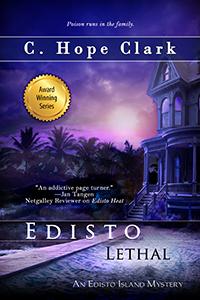
The Poe family (yes, that Poe) celebrates the matron’s eightieth birthday at Edisto Beach. But in a macabre sense of legacy, the members assume a vengeful script of poisonous tricks as they vie for a place in grandmother’s Will. When the grandson is poisoned,
Edisto Beach Police Chief Callie Morgan arrives to nail the culprit, only for the family diminish the act to a prank. All possess the culinary skills endowed upon them by the Grand Dame Doris Woolf Poe, author of a renowned cookbook, and the culprit could be any one of them. Then when Callie learns her son knows the Poes, her professional and personal lives cross into very uncomfortable territory. (Available at Hope's site or wherever books are sold.) BETA READERS
A beta reader is a reader who reviews a book before published to provide constructive feedback. There are lots of versions of beta readers, but they are good tools to have for any book-length manuscript, and even for those in freelance, nonfiction material. It's another set of eyes on the
near-finished product. What do they do? 1) They respond as to whether the piece works for a reader.
2) They look at the big picture.
3) They might throw in copyediting. Do they get paid? Depends on how much you want done. Most review just for the joy
of reading it ahead of the general public. Others wish some sort of compensation, but not on the level of a professional editor. But payment is a one-on-one discussion, not an advertisement. How many do you need? Up to you. However, too many and you can confuse yourself and make too many changes in too many directions. A good number is four, but that's after you've culled
through enough of them to find those you appreciate and trust. Where do you find them? Anywhere. Friends, family, acquaintances, social media. However, I don't use family and close friends. I want people who are avid readers of my genre and who love editing. I want people who will adhere to a deadline. I'll give a lot of people one crack at it, but I've collected four right
now I am very comfortable with, who do not fear beating me up, and who are familiar with my work. I didn't find them overnight. Look at https://www.Reedsy.com or https://booksirens.com/ but those already knowledgeable of you and your work is the more comfortable place to start. Who is a good match? Someone who adores reading. Someone who appreciates your genre. Someone who
will follow-through. And hopefully someone who knows the editing app (Track Changes) on your writing program. How can you better work with your beta? Be clear what you'd like them to do. A list would be helpful. How broad or how finite. Big picture or details. Give them enough time to do a good job. I have four who have entirely different ways of reviewing, and I love
that. Does a beta reader take the place of an editor? Depends on how solid and knowledgeable your betas are, but usually you will still need an editor. A lot depends on your experience and the experience of your beta readers, but few writers can do without an editor.
-Apr 15, 2026 - Book Club, Noon to 2 PM - Elgin, SC (members only) -April 16, 2026 - Brookhaven Book Club,
3001 Stanbury Dr, Matthews, NC -7-9PM -April 18, 2026 - The Coffee Shelf, 130 Amicks Ferry Rd, Chapin, SC 29036 -8AM-noon -April 30, 2026 - Edisto Bookstore, 547 SC-174, Edisto Island, SC - 3-5PM -June 4, 2026 - Chapin Library, Chapin, SC - 1-2 PM -June 13-20, 2026 - Gutsy Great Novel Retreat, Bar Harbor, Maine - Hope as author-in-residence -July 25, 2026 - Smoking Guns Sisters in Crime Zoom meeting - Noon - Zoom -October 27-28, 2026 - SC Library Conference, Columbia Convention Ctr - lunch speaker -November 15-21, 2026 - Edisto Beach, signings TBD
Email: [email protected] to schedule events, online or otherwise. “Millions long for immortality who do not know what to do with themselves on a rainy Sunday afternoon.” – Susan Ertz
Writing when you’re down
How to keep going – and earning – when you’re not feeling yourself
By Dan Brotzel
Over the last two years I’ve experienced a series of setbacks that have taken quite a toll
personally and professionally – bereavements, illness and accidents in the family, caring for ageing relatives, plus losing my job, ample pitch rejections, and all the rest. In recent months, unfortunately, this has led to low-level depression, and with it a lack of energy, self-esteem, and motivation. I work alone and rely on myself to keep motivated, disciplined, and endowed with work. I used to spring out of bed at 5am to novelise
for an hour before the kids got up and the day job started. Recently, however, I’ve gone weeks without writing a word of fiction and contemplated giving up altogether. I used to pride myself on writing 1000 words of content in an hour, while lately it’s taken me till midday to nail a sentence. Slowly, however, I’m climbing out of the tunnel, and feeling a bit more positive and productive. I want to share what kept me going and
writing through this low time. Prioritising paid work over speculative work Despite slaving away at fiction for over a decade, with an agent and several books published, the fact is that fiction is still only a sideline for me in terms of earnings. It’s speculative, aspirational work that no one actually screams for or promises to buy. And it takes up a great
deal of headspace and mental energy. So I decided to focus on essential work. There is validation and satisfaction in getting paid and ticking items off your to-do list. Likewise, when creative writing feels too hard, now may be a good time to focus on lower-effort things like updating your author site or compiling your next Substack post or email newsletter. Write some of your easier freelance work. Be gentle on yourself For me, accepting and embracing what was happening was the key thing. When you are low, plans and projects and deadlines you’ve set your heart on may simply not be realistic or achievable anymore. Letting go or shelving them can reduce your mental burden. I tried not to judge my current self by my usual self’s performance or productivity. Break things down and set boundaries At one point I received edits back on a new novel that had to be turned round in three weeks. My usual self might have blitzed through them in a couple of days, but I wasn’t my usual self. So one week I focused on the in-line edits, next week I did the structural edits, and the week after I did a final read-through. This format
made a suddenly daunting task doable. Or sometimes, just to make progress on a project, I’d set my phone alarm for an hour and make myself keep going till it went off. Follow the One Thing approach If you do nothing else today, what is the one thing that needs to get done? Sorting that gives you the boost of a productivity win and will make the next day less
stressful. It’s a useful way to prioritise if you pride yourself normally on being someone who gets 20 things done in a day, and it also helps avoid the temptation to focus on easy or enjoyable things that aren’t as urgent or important. Keep on reading Whenever I’m at my lowest, reading becomes a great consolation. As many have said, the single best tip for
writing better is to read more. For a writer, reading is never passive either – it gives me lots of ideas, both in ideas to pitch and ideas to consider for my own writing. I always have a notebook by me to jot notes, so as long as I was still reading, I felt I was still writing.
Finally, I told myself that this period wouldn’t last forever. Shelving or deprioritising things didn’t have to mean abandoning them. It won’t always feel like this, and when better
times come, there are ideas and projects to return to with new energy and insight.
BIO - Dan Brotzel’s latest novels are Thank You For The Days and The Wolf in the Woods. He also writes widely on Medium https://medium.com/@danielbrotzel ID 20757194 © Marcel De Grijs | Dreamstime.com
THE ALPINE POETRY PRIZE
https://alpinefellowship.com/poetry-prize
£10 ENTRY FEE. Deadline May 1, 2026. Awarded for the best poetic response on the theme of JOY. First place: £3,000, Second place: £1,000, Third place: £1,000. You
may submit only ONE poem per entry. There is a maximum of 500 words per entry. THE SUPERNATURAL WRITING PRIZE - THE KIPLING SOCIETY
https://www.kiplingsociety.co.uk/news/the-supernatural-2026-writing-prize.htm
£8 ENTRY FEE. Deadline May 1,
2026. Subject Supernatural. First Prize £350. Second prize £100. Third Prize £50. Maximum of 2500 words excluding the title. No minimum length. Competitors give their permission for the winning entries to be published in the Kipling Journal, and subsequently on the Kipling Society’s website. F(R)ICTION CONTEST
https://frictioncontests.submittable.com/submit
$10-$15 ENTRY FEE. Deadline: May 15, 2026. Short stories: 1,001 – 7,500 words. Poetry: up the three pages per poem. Creative Nonfiction: up to 6,500 words. Flash fiction: up to 1,000 words per piece. Accepts work written in English from anywhere in the world—regardless of genre, style, or origin—and welcome speculative writing and experimental literature. Short story first prize
$1000. Flash fiction first prize $300. Poetry first prize $300. Creative nonfiction first prize $1000. MOLLY KEANE CREATIVE WRITING PRIZE
https://waterford.submit.com/show/366
NO ENTRY FEE. Deadline May 1, 2026. Prize of €500. An open competition for people resident on the island of Ireland for a short story. The limit for each piece is 2000 words. LIGHT CONTEST
https://light4ph.org/contest/
https://light4ph.submittable.com/submit
$5 ENTRY FEE. Deadline May 1, 2026. Using art, letters, stories, and poetry, tell us: How might the roots of
your joy sustain your wellbeing? It is recommended that letter submissions are between 250 to 500 words, short stories 2000 words. Poetry one page. Paid submissions will be considered for both publication and prize money. Free submissions will only be eligible for publication. GRANTS / FELLOWSHIP / CROWDFUNDING SOUTH ARTS INDIVIDUAL ARTISTS GRANTS
https://www.southarts.org/grants-opportunities
Deadline April 30, 2026. Up to $3,000 to support professional development or business enhancement (e.g., marketing materials or
branding). Applicants must reside or operate within South Arts’ nine-state region: Alabama, Florida, Georgia, Kentucky, Louisiana, Mississippi, North Carolina, South Carolina, or Tennessee. EASTERN OREGON UNIVERSITY MFA FELLOWSHIPS
https://www.eou.edu/mfa/tuition/
MFA program costs $6,000-$7,000
less per year than most comparable low-residency programs. Merit-based scholarships are available to students who have been accepted into the Master of Fine Arts in Creative Writing program and admitted to the University. The award amount is generally up to $5,000 per year in tuition remission. CALIFORNIA GRANTS
https://arts.ca.gov/grant_program/individual-artists-fellowship
If you are an individual artist, apply to the statewide fellowship program through the regional administering organization (AO) that serves your county. CAC Emerging Artist Fellows – $5,000.
CAC Established Artist Fellows – $10,000.
CAC Legacy Artist Fellows – $50,000.
BOOK RIOT
https://bookriot.com/write-for-book-riot/
Write something smart, funny, interesting, or provocative about books in the space of about 600-900 words. Especially interested in writers knowledgeable in comics and manga, children’s lit, and
romance. Please send us two writing samples for consideration. Flat fee of $50 or $100 per post based on the post topic and post length. Offers other paid writing opportunities in addition to regular writing for the site. PSEUDOPOD
https://pseudopod.org/submissions/
A genre magazine in audio
form. Looking for horror: dark, weird fiction. Grim realism or crime drama, to magic-realism, to blatantly supernatural dark fantasy. Publishes highly literary stories reminiscent of Poe or Lovecraft as well as vulgar shock-value pulp fiction. Pays the pro rate of $.08/word for original fiction, $100 flat rate for short story reprints, and $20 flat rate for flash fiction reprints (stories below 1500 words). LIVE SCIENCE
https://www.livescience.com/how-to-pitch-live-science
Publishes freelance news, features and explainer pieces. Covers everything from fascinating archaeological discoveries from ancient Egypt, to bizarre ancient sea monsters, to wild theories about the birth and death of the universe. Pays up to $400. DAME MAGAZINE
https://www.damemagazine.com/pitch-dame/
Pays $350-750 for reported stories, depending on the length and level of reporting. A women-led, independent, reader-funded magazine dedicated to producing journalism that is accessible, intersectional, illuminating, smart, progressive, and incisive. CHRISTIAN STANDARD
https://christianstandard.com/writersguidelines/
Christian Standard is written by and for leaders in independent Christian churches and churches of Christ around the world. Pays 10+ cents/word. Seeking news items to report on our website. Always looking for well-written Communion
meditations.
CHURCH PUBLISHING
https://churchpublishing.org/pages/church-publishing
Resources to support The Episcopal Church and beyond—from official worship materials, such as hymnals and prayer books, to professional resources for clergy, lay
leaders, and the wider church community. MOREHOUSE PUBLISHING
https://churchpublishing.org/pages/morehouse-publishing
Books for general readers that motivate, challenge, inform, and inspire—from leadership and spirituality to social justice, wellness, personal growth, current
affairs, and more. FOREVER YOURS
https://www.hachettebookgroup.com/landing-page/forever-yours-submission-guidelines/
All styles of romance, particularly contemporary, diverse reads, romantic suspense, cowboys, historicals, and paranormal. Not
looking for YA, fantasy, mystery, general fiction, or nonfiction. Novels 50,000-100,000 words. Novellas 25,000-50,000 words. JADED IBIS PRESS
https://jadedibispress.com/submissions/
Themes related to social justice, persecution, feminism, or reveals something about what it’s like to struggle
through this world, with all the related losses and triumphs and unanswered questions. Opening soon for our 2026-2027 publication. IG PUBLISHING
https://www.igpub.com/about-ig/
Ig Publishing is a New York-based award-winning independent press dedicated to publishing original literary fiction and
political and cultural nonfiction.
FUNDSFORWRITERS FINE PRINT Please forward the newsletter in its entirety. To reprint any editorials, contact [email protected] for permission. Do not assume that acknowledgements listed in your publication is considered a valid right to publish out of ours.
C. Hope Clark
E-mail: [email protected]
140-A Amicks Ferry Road #4
Chapin, SC 29036
http://www.fundsforwriters.com Copyright 2000-2025, C. Hope Clark
ISSN: 1533-1326 Our subscriber list is NOT made available to others. Use information listed at your own risk. FundsforWriters gives no warranty to completeness, accuracy, or fitness of the markets, contests, and grants although research is done to the best of our
ability. FundsforWriters finds open submission calls, contests, and markets from a wide variety of sources, including Erika Dreifus' Practicing Writer
newsletter, Erica Verrillo's blog, Authors Publish, Poets & Writers, Duotrope, Winning Writers, Write Jobs Plus, LinkedIn Jobs, Emily Stoddard, and other newsletters and online sites. Many announcements are submitted directly to FundsforWriters. All must be paying opportunities. Contests must pay a minimum of $200 first place. Submit potential listings to [email protected] **Note that FundsforWriters.com places paid advertising in this newsletter. ALL ads are related to writers and the business of writing, screened by FundsforWriters to make sure the information is suitable for writers and their endeavors to improve their careers. While the mailing list is
not sold to third parties, other parties do advertise in the newsletter, to include the occasional solo ad. You will not receive this newsletter without your permission. It's physically impossible since recipients must opt-in, giving us permission to send the newsletter. If at any time you no longer wish to receive the newsletter, click the UNSUBSCRIBE link at the bottom of each newsletter. We want you to enjoy this newsletter at your pleasure, not be forced to read anything you do not wish to
receive. Direct any complaints, suggestions, and accolades to Hope Clark at [email protected]. We are an anti-spam site. | |
|
|
|